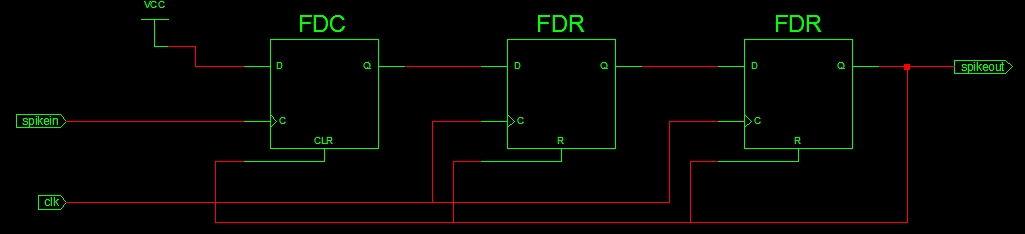
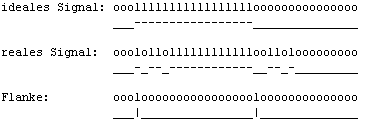
Das hier ist eine Flankenerkennung mit einer vorgeschalteten Synchronisationsstufe.
Diese Beschreibung lässt sich sehr effizient in ein FPGA implementieren und wird ohne große Anstrengungen bis zu 400MHz schnell ausgeführt. Durch die Verwendung eines lokalen Schieberegisters (Variable sr) bleiben alle relevanten Signale lokal.
library ieee;
use ieee.std_logic_1164.all;

entity edge_detect is
  port (async_sig : in std_logic;
        clk       : in std_logic;
        rise      : out std_logic;
        fall      : out std_logic);
end;

architecture RTL of edge_detect is
begin
  process
    variable sr : std_logic_vector (3 downto 0) := "0000";
  begin
    wait until rising_edge(clk);
    -- Flanken erkennen
    rise <= not sr(3) and sr(2);
    fall <= not sr(2) and sr(3);
    -- Eingang in Schieberegister einlesen
    sr := sr(2 downto 0) & async_sig;
  end process;
end architecture;
Daraus wird dann:...
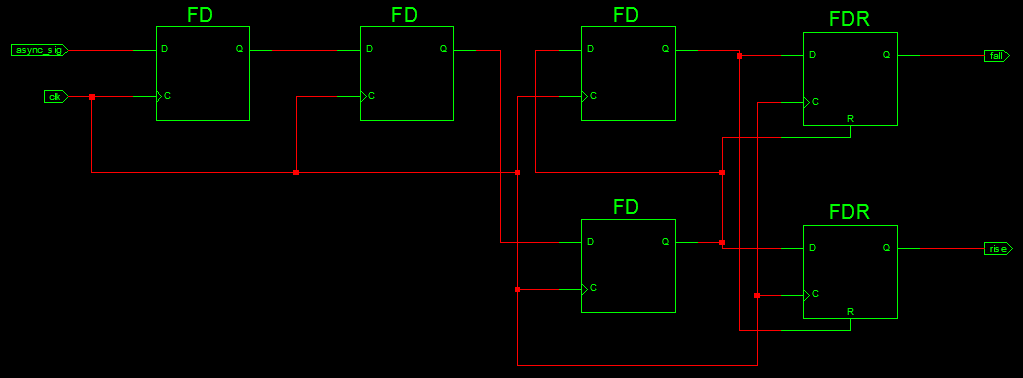
Flankenerkennung mit Synchronisationsstufe
Hier eine Testbench:
LIBRARY ieee;
USE ieee.std_logic_1164.ALL;
USE ieee.numeric_std.ALL;
use ieee.math_real.all;

ENTITY tb_edgedetect_vhd IS
END tb_edgedetect_vhd;

ARCHITECTURE behavior OF tb_edgedetect_vhd IS
   COMPONENT edge_detect
   PORT(
      async_sig : IN std_logic;
      clk : IN std_logic;
      rise : OUT std_logic;
      fall : OUT std_logic
      );
   END COMPONENT;
   --Inputs
   SIGNAL async_sig :  std_logic := '0';
   SIGNAL clk :  std_logic := '0';
   --Outputs
   SIGNAL rise :  std_logic;
   SIGNAL fall :  std_logic;

BEGIN
   -- Instantiate the Unit Under Test (UUT)
   uut: edge_detect PORT MAP(
      async_sig => async_sig,
      clk => clk,
      rise => rise,
      fall => fall
      );

   clk <= not clk after 5 ns;

   -- Ein zufälliges asynchrones Signal erzeugen
   stim : process
     variable seed1, seed2 : POSITIVE;
     variable Rand : REAL;
     variable IRand : INTEGER;
   begin
     -- Zufallszahl ziwschen 0 und 1
     uniform(seed1, seed2, rand);
     -- daraus ein Integer zwischen 50 und 150
     irand := integer((rand*100.0 - 0.5) + 50.0 );
     -- und dann diese Zeit abwarten
     wait for irand* 1 ns;
     async_sig <= not async_sig;
   end process;

END;
Und das ist die resultierende Waveform:
Als kleiner Gimmick
Wenn statt
    rise <= not sr(3) and sr(2);
    fall <= not sr(2) and sr(3);
die folgende (genau funktionsgleiche) Beschreibung
    rise <= not sr(3) and     sr(2);
    fall <=     sr(3) and not sr(2);
verwendet wird, kommt das dabei raus:
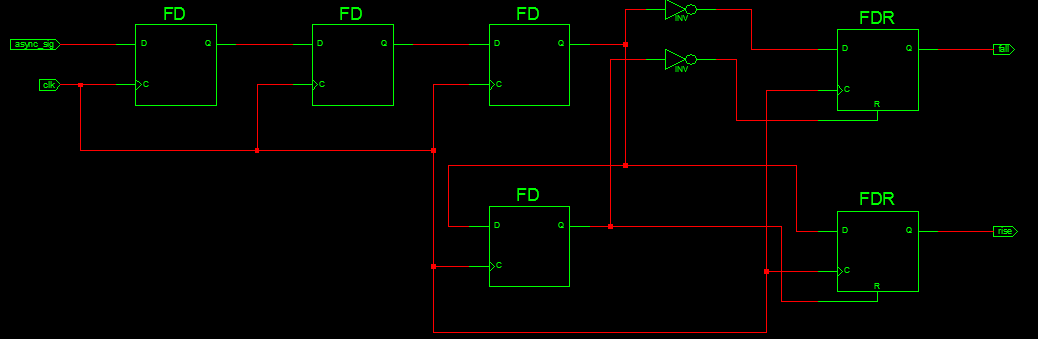
Unnötige Inverter
Zwei unnötige Inverter. Die Xilinx-Toolchain ist immer für Überraschungen gut.